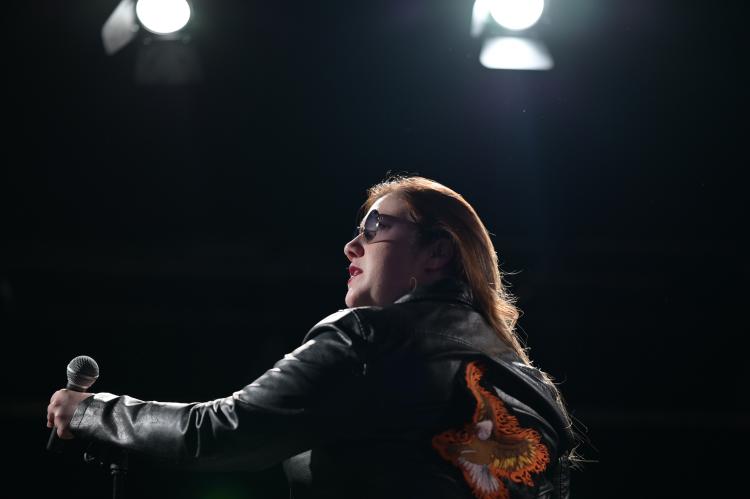
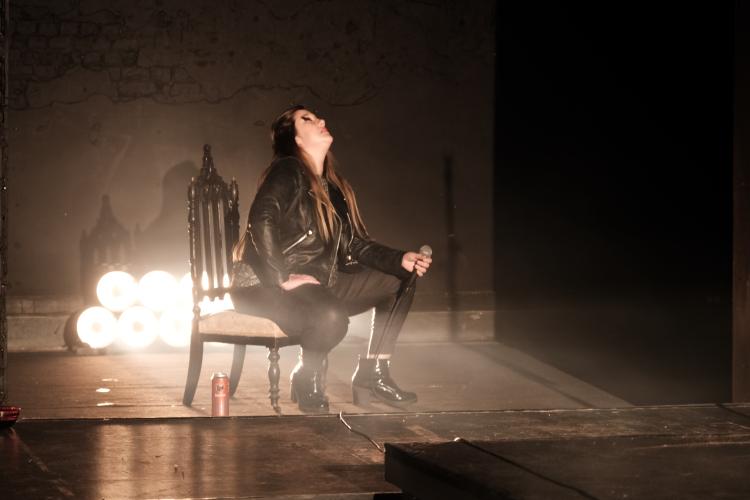
"I'd like to be able, one day, to say 'popular culture' without having to add 'in the noblest sense of the term'."
Interview of Aurianne Servais about "Sang pour Sang Johnny"
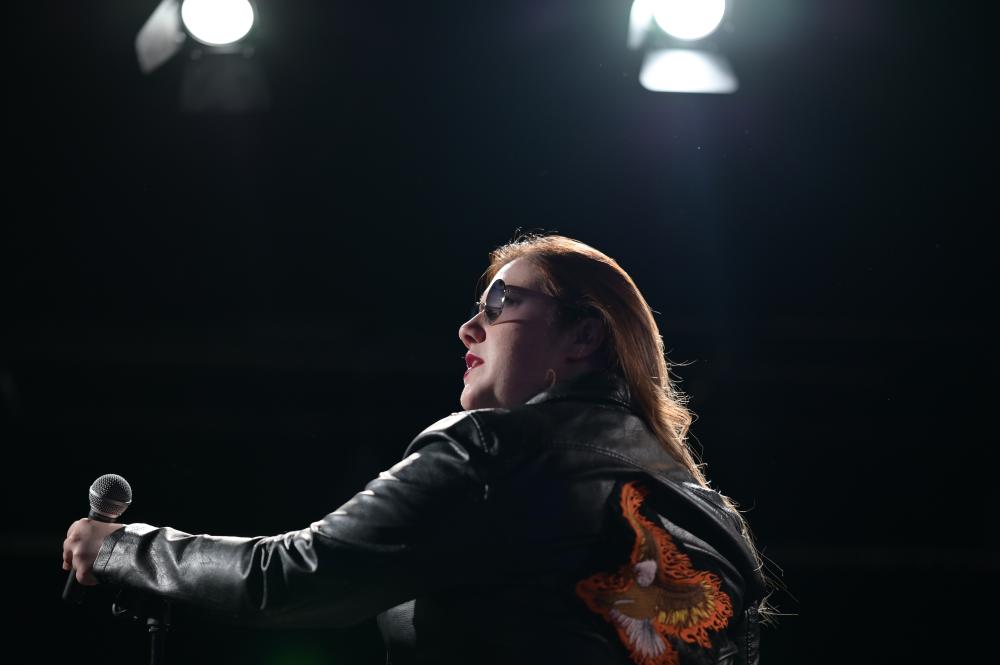
Following her young audiences production The Mermaids' Belly, Aurianne Servais continues her exploration of autofiction at the crossroads of theatre and live music. In Blood for Blood Johnny, she lends her voice to the words of a community of fans she met while developing the performance. By taking on a virile figure who embodies a taste for spectacle and excess, she playfully challenges our assumptions: yes, a woman can wear leather and command as much power as Johnny, leaping from a helicopter into the Stade de France.
What is your connection to Johnny Hallyday?
Johnny has always been part of the musical landscape I inherited from my mother. Ever since I was a child, music has played a major role in the moments we shared together. French chanson is something that brings my family together.
From the moment I discovered Johnny, I was struck by the grandeur of his concerts. What fascinated me then, and still does today, is how he never seemed to place limits on what he could do on stage, while remaining profoundly sincere. He was the first singer I knew who could fill an entire stadium. As a little girl, I told myself that one day I would do a stadium tour like Johnny Hallyday.
What troubled me, however, was that the only model I saw was a man. Even as a child, there were many things in that highly masculine world—rock music, bikers, leather, spectacle—with which I could not identify. It felt as though there was no place for me there.
As I grew older, what stayed with me was Johnny's music and what he represented for his fans. The day he died, my mother and I were pulling an all-nighter watching films together. Around five in the morning, television programming was interrupted by a breaking news announcement: "Johnny Hallyday has died." We spent the entire day watching the coverage. Neither of us slept. I was deeply moved by the way this community came together to pay tribute, celebrate, mourn, and above all support one another through their grief. That was when an idea began to take shape, eventually leading me to create a performance about Johnny Hallyday's fans.
You met fans as part of your creative process. What place do they occupy in the performance?
What mattered most to me was giving this community a voice and placing their stories at the centre of the work.
I began with documentary research into both Johnny's life and his fan community. I read books, watched series, interviews and documentaries, listened to podcasts, met collectors, and visited exhibitions. This allowed me to start gathering testimonies around themes I wanted to address in the performance: fatherhood, stage persona, addiction, violence, relationships with women, grief, and more.
I then developed an interview protocol and set out to meet people willing to talk about their idol. I also interviewed every member of the creative team: Raphaële, who plays electric guitar; Jeanne, who plays drums; and my assistant Nelly, who even designed an interview for me so that I too could be interviewed.
From there, we began our stage research, creating material from all the voices we had gathered—our own, those of the fans, and those of people close to Johnny.
Once the research phase was complete, I wrote the text using their words, their images, and their favourite songs. In the performance, the voices of the three characters—Jo, Raph and Michelle—are composite voices that bring Johnny Hallyday's fans to the stage and allow them to be heard.
How do you convey the tension between the intimate experience of having an idol and the collective identity of a fan community?
In the story, Joséphine, the central character, cannot come to terms with the loss of her idol. Her grief is deeply personal. It is tied to her childhood and to the place Johnny occupies in her life. Yet eight years later, she remains unable to move on.
The answer she eventually finds comes through a tribute band. It is through the two women she meets, through their shared experiences of music and their different views of Johnny, that she is finally able to let go. Together, through solidarity and collective experience, they help one another through the mourning process.
Each of the three women has her own intimate relationship with Johnny, her own understanding of his career and what he represents in her life. Yet together they form a group. Something emerges from that tribute band: an identity, a shared energy, a common presence. That is what I wanted to explore through these three characters—the interplay between individuality and community, personal experience and collective identity.
What I love about documentary storytelling is that the more intimate and personal a testimony becomes, the more universal it often feels.
Although the performance is rooted in the world of Johnny Hallyday's fans, every audience member can recognise something of themselves in it. More than a performance about Johnny Hallyday, it is a performance about love, the need for identification, the desire to belong, and the freedom to be who we want to be while being accepted as we are.
The performance combines autofiction, theatre and live concert. How did you approach this intersection of forms?
After gathering documentary testimonies from Johnny's fans, the voices of the actresses and musicians who accompany me became just as important in shaping the work and informing their characters. What moves them? What makes them angry? The three of us went through that process together. The aim was never for the characters to be direct versions of ourselves, but rather for them to be infused with the things that matter to us as artists.
My creative process always begins with images or tableaux built around a theme or a question: class prejudice towards fans, how to mourn a role model, what we do with what our parents pass on to us, and so on. Each tableau is paired with a song from Johnny's repertoire. I choose these songs for what they express, their aesthetic qualities, their energy, or the emotions they carry.
As we explore each scene in rehearsal, I consider how the song should be performed, what dramaturgical role it plays within the story, and how it advances the journey of the three characters. Should it remain close to Johnny's original version? Should it be performed as a voice-and-piano arrangement? A cappella?
Music, stage research and our own questions become intertwined, and little by little the story emerges from that process.
How do you bring Johnny Hallyday's larger-than-life presence to the stage?
For me, Johnny's sense of grandeur lies in seeing these three women—musicians and performers—claim the space and visibility they desire without having to justify themselves.
What I love about theatre is watching actors perform. That sense of excess is expressed through playfulness: the pleasure they take in acting, laughing and singing. Throughout the performance, these women invent games and characters for themselves, much like children who one day want to be queens and the next day mermaids.
Here, they become rock stars, cowgirls, Michel Drucker, sexist journalists full of class contempt, and more. They recreate a helicopter entrance, revisit an episode of the television show Champs-Élysées, and embrace the spirit of spectacle.
What emerges from all of this is a refusal to hold back—a desire to go all the way and take pleasure in doing so. It is an invitation to share the stage, to bring one's voice and body into the experience alongside these women who step into the spotlight, take the microphone, and encourage us to take our place with them.
Is Blood for Blood a way of questioning the notion of "popular culture"?
Popular culture is difficult to define. Why? Because it cannot be confined to a fixed category. It is constantly changing and evolving alongside society.
As its name suggests, popular culture belongs to the people. It reflects the society that creates it, sustains it and consumes it. That is precisely what I wanted to explore in this performance.
Johnny's fifty-seven-year career spans a society that has undergone profound transformations. The aim is not to throw everything away, but rather to question what we inherit, what came before us, and why.
I do not believe there is a right or wrong answer to these questions. Everyone has their own answer, and that answer is valid. As I mentioned earlier, the more intimate and personal something is, the more universal it often becomes.
I believe that popular culture—in the noblest sense of the term—belongs to all of us. It resonates because it evolves alongside us. One day, I would like to be able to say "popular culture" without having to add "in the noblest sense of the term".
I hope we can learn to enjoy and engage with the things we love without having to hide parts of ourselves, while still retaining the ability to question them critically.