


"Christian culture has its own imaginary realm of exclusion, traces of which we must seek out today"
Interview with Léa Quinsac and Solène Valentin about their production “The Glorious Procession of the False and Sad Nuns”
A gruesome, Grand Guignol-style horror thriller in which the voices of nuns echo across the airwaves to unravel a mystery from the past. Interview conducted by Sophie Thomine.
Why did you choose the figure of the nun as the starting point for this new production?
The notion of the sacred lies at the heart of our theatrical obsessions. In *La Litanie des Agonisantes*, we sought to subvert the female archetype, and we did so by reviving the memory of a certain feminine mysticism that runs through the history of medieval Europe. There was Pope Joan, a myth concocted to consolidate male control over the Catholic faithful, and there was Dona Maria de Gaucin, an Andalusian Carmelite who left the convent to become a bullfighter. The Megalomartyr, for her part, was a martyr multiplied many times over, who bore within her all manner of torments. On this occasion, we were interested in the figure of the nun in order to portray her within the context of a community and a religious history.
We do not wish to approach spirituality through the prism of beliefs, but rather through the cultural and religious heritage of Western Europe: mystical memory, rites and practices, archetypes, and relationships with death and the invisible. For us, this is an opportunity to present nuanced and complex characters who come up against a history that seems to offer them no possible reconciliation. To speak of religion is to forge a connection with the invisible world. The first question that often arises is that of belief in an afterlife. Taking as our premise women with a connection to faith allows us to create a mystical space in which hauntings can occur and cast doubt on what we see. Blurring the boundaries between the world of the living and the world of spirits.
Like any culture, Christian culture has its own imaginary zone of exclusion, traces of which we must seek out today. We therefore began researching real women, stories in which religiosity and marginalisation are not only associated but intertwined, frozen within marginalised bodies. Real stories of stifled dissent.
At what point did the themes of spirituality and queerness intersect in your research? Why is it important today to tell stories in which spirituality and lesbian love are no longer at odds?
When she was fifteen, following a conversation and some time spent with a nun, the cloistered life of the nuns struck Léa as an act of emancipation. Being married to an invisible man, living surrounded by women and seeing her future secured through faith, love and hymns were all solutions that resonated with her teenage anxieties. She wanted to become a nun. Today, she realises that this was, in fact, her first experience of falling in love with a woman. This realisation inevitably goes hand in hand with what the Church has done – and continues to do – to queer people. How can one be made in God’s image when God is a man? How can one believe in something when one is excluded from God’s love? How can one reconcile one’s need for immensity, the absolute and faith with desires and lives deemed ‘deviant’? With this play, we want to encourage collective reflection on what is sacred, and to offer a queer, free and sensitive perspective on the weight of convention.
We have borrowed the phrase ‘queer sacred’ from the author Constant Spina, who, in his book *Manifesto for a Deviant Democracy – Queer Loves in the Face of Fascism*, offers concrete, intimate and spiritual solutions to counteract our fascist legacy. He does not shy away from looking our society straight in the eye in order to cultivate new utopias. In his view (and we share this perspective), fascism is a fully-fledged form of Christian patriarchy. We believe it is important to recall that in every religion, the spiritual message almost always differs from its institutional implementation. This is certainly the case with Christianity. In fact, it now seems to us more necessary than ever to reclaim our religious heritage. It is important today to tell stories in which spirituality and lesbian love are no longer at odds, so as not to leave the monopoly on religion solely in the hands of conservatives, and thus to re-enchant our world.
We are committed to portraying women who finally find a place where they feel they belong and where they can express themselves, with all their vulnerability, awkwardness and quirkiness. Women who, together, can tell their own versions of events, hope for their own world and tear down the concept of normality. Where the suffering they may experience in the face of the cultural ban on loving one another no longer exists.
‘In the lived experiences of some queer people, religion and spirituality have certainly inflicted harm, but they are also the foundational roots of a culture and a past. We do not wish to reject our roots, but to reflect on how these forms of spirituality can nourish our queer lives. Spirituality, when lived with love, is a practice of the ‘threshold’. That said, in a queer society, what place should spirituality be given? (…) ‘When we fail to recognise the sacred, we also fail to recognise what we must defend and why.’ Constant Spina – Manifesto for a Deviant Democracy
For this production, you undertook research into religious women. What role does historical and religious documentation play in the writing process?
We commissioned the writer and director Héloïse Ravet to write the script. As she herself is convinced that theatre is a means of reinventing new rituals, she set about creating characters who have a unique relationship with the sacred.
The three of us each selected portraits of women from which the characters in our play were imagined. We are interested in how these women developed strategies for survival linked to their faith during different periods. Among them is Hildegard von Bingen, a medieval composer, healer and abbess who was criticised for her systematic use of music in her religious services. She defied the papal ban: at the time, women were not allowed to sing in churches. Hildegard was a great source of inspiration for the character of Hilde, who sets up a pirate radio station and gives her fellow women a platform to express themselves. Through music and song, she finds a means of emancipation and resistance. We also wanted to shed light on little-known or unknown aspects of Christian history, particularly through the character of Mahaut and ‘Liberation Theology’. This school of thought, which was accompanied by a social justice movement, emerged in the 1960s in Latin America during the era of military dictatorships.
Our thriller also draws on the story of defiance told by the Beguine Marguerite
Porete, born in Belgium in 1250 and author of the book *The Mirror of Simple and Humble Souls Who Dwell Only in the Will and Desire for Love*. ’ As astonishing as it may seem, her radical assertion that ‘God is love’ earned her the status of a dissident. She was condemned to be burnt at the stake in the Place de Genève in Paris. Then there is the 17th-century singer and duellist Julie d’Aubigny, who was in the habit of dressing as a man and who was in a relationship with a woman before the latter was sent to a convent for reform.
We also sought to honour the memory of all the women confined
in religious and penal institutions tasked with punishing, controlling and reforming those deemed immoral. Thus, we have set our story in a convent inspired by the
Congregations of the Good Shepherd in France and the Magdalen Laundries in Ireland, where the Irish singer Sinead O’Connor – whom we mention in the play – spent over a year of her life.
The work on the costumes plays a very special role in your productions;
what were your inspirations?
Our company’s visual world is built upon a dramaturgy of the
pirouette, which could be described as a ceaseless quest for the oxymoron. We therefore seek to exaggerate and distort reality by weaving into the very real stories we recount strange, even grotesque characters drawn from other tales, steeped in mysticism, folklore and superstition. To this end, our recognisable figures – nuns, detectives, the Mother Superior and a lecturer in the convent – draw inspiration from the vampire Lucy Westenra, the ‘bishop fish’ of medieval legend, and other banshees. We also draw inspiration from the paintings of Apolonia Sokol, Miriam Cahn, Tahnee Lonsdale, Elen Bezhen and Julius Hoffmann, the sculptures of Wael Shawky, and the visual world of Ulrike Ottinger’s films, each of which, in its own way, practises the art of incongruity. This quote from Nicolas de Staël echoes the way in which we begin to conceive of the costumes: ‘By piecing together the fragments of a fragmented world, we multiply the meanings. It is not entirely clear whether it is the composition that creates the landscape or the landscape that creates the composition.’
We have approached the dramaturgy of the costumes through several themes, amongst which three major strands stand out: confinement, standardisation, and the proliferation of evil. For each theme, we seek to apply a specific technical treatment.
The characters in the play appear (with one exception) at the very least in pairs, if not in trios or quartets. The silhouettes of each of these groups harmonise with one another. Through the standardisation of the nuns’ costumes, we aim to convey the convent’s determination to destroy their individual identities, in an attempt to force them to conform to a single, shared way of thinking. Some of them are anonymous. They all have the same ‘face’, an abstract version of that of the Mother Superior. The theme of forgetting and memory features prominently in the play: we therefore encounter faceless women – for their histories and memories have been torn away – and we hear of men whom we shall never see. Thus, the incongruity of the costumes serves to evoke these truncated stories, and all that has been concealed or distorted by those in power – mirrors of a structurally violent society.
Other techniques are used to explore the themes mentioned above. For example, we employ systematic distortion, the exaggeration of silhouettes, transformed faces, human beings with animal heads, and blood-soaked scenes; but also, in terms of colour, through the use of red in the costumes and the set design. We see this reflected in the very structure of the set design, as well as in the figures of authority. We also see this colour on the nuns’ gloves: evil has crept into the convent through touch.
The use of colour also draws on colour combinations evoked in religious narratives, such as the pairing of red and blue (calvary and grace), purple, the sudden appearance of white, and the light-and-shadow contrasts characteristic of biblical paintings. Finally, the blending of historical periods in the costumes allows us to bring a story into the present whilst retaining its historical marks, revealing the traces of the past that linger in our present-day history.
What are the key principles that guided the design of the space:
confinement, ritual, secrecy?
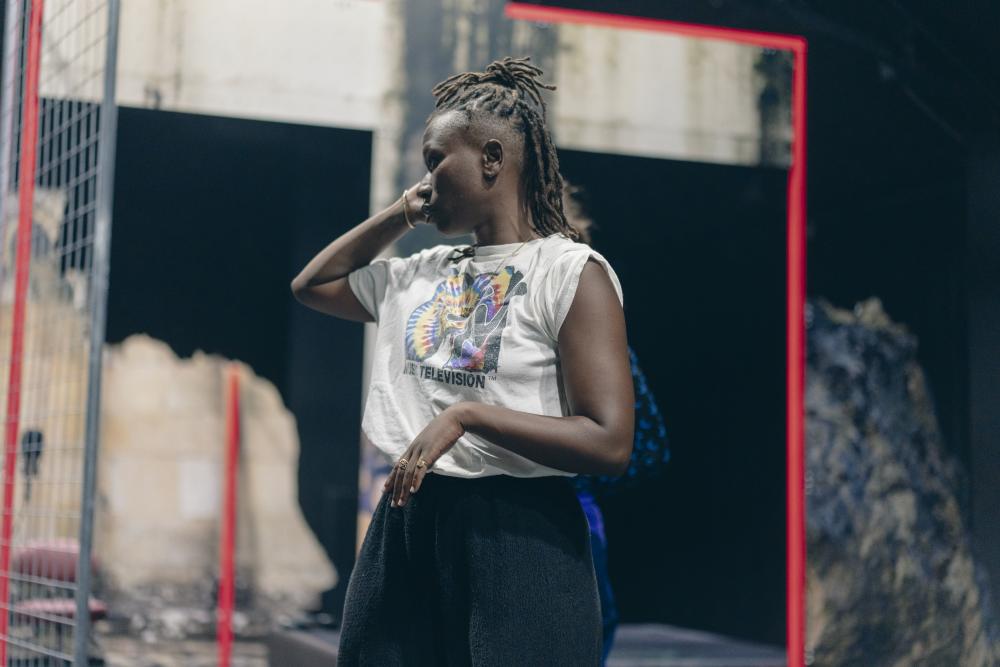
We wanted a transformable and evolving space, one that would allow us to create timeless images whilst incorporating concrete elements (the radio station, a section of the convent, the police holding cell). We chose the Sainte Marie de la Tourette convent, built by Le Corbusier in 1959, as the starting point for our thinking about the space. Its brutalist form directly reflects the desire to build an ultra-functional, highly organised world that seeks to rationalise every aspect of human activity. This desire to organise life within an over-structured and over-delimited daily routine seems to us to be linked to the compartmentalisation of Christian patriarchy, which we wish to discuss. The Brutalist aesthetic evokes the notion of confinement. It also evokes something of the nature of underground passages and thus of flight, of a desire to escape, of secret passages. These passages—openings allowing swarms of men to slip through and sow horror—are also the nuns’ escape route. These elements are reflected in the open structure conceived by Marie Szersnovicz. She has designed the set pieces as mobiles in a modelling/glitch aesthetic, evocative of a blurred reality, obscured by hazy memories, years of torture and trauma. Each element has a dual meaning, enabling it to accommodate several scenes set in different locations. The space is conceived as a succession of altarpieces. This allows us to create surprises that echo the world of the thriller, with apparitions and disappearances. Through a combination of meaning, narrative threads, evocations and symbols, we craft the show’s aesthetic.
How does the sound and musical design contribute to this atmosphere, which blends elements of liturgy, crime thriller and horror film?
We are working with the musician Tratenwald (Léonie Floret) on the musical composition and with Laure Lapel on the sound design. Their collaboration enables us to weave a genuine dramaturgy of sound and to immerse the audience at the heart of our narrative.
Léonie’s character plays and sings on stage, whilst Laure creates soundscapes that sometimes incorporate musical themes devised by Léonie.
The use of live music is seen as a way for the audience to identify with the characters navigating the narrative: it demonstrates a desire to connect and creates a sense of recognition. Music is conceived as the guiding thread – more or less overt – of the story we are constructing, performed live by the radio presenter. Tratenwald’s highly organic compositions convey the need for immensity that we wish to explore.
Together with Laure, we aim to develop a dramaturgy centred on the disruption of frequencies. Laure works to create a subtle network of hallucinatory glitches and interference between different worlds. She crafts soundscapes that provide points of reference within our fragmented narrative and accompany the multitude of characters on stage. The sound design is also a way for us to introduce stark contradiction with what is happening on stage by bringing different registers into conflict.
We have in mind the soundtrack to the film *The Conclave*, composed by
Volker Bertelmann, whose very present, baroque and grandiloquent music does not throw the film off balance: on the contrary, it accompanies it at a breathless pace. The music and the sound design keep us on our toes and create shifts in momentum.
