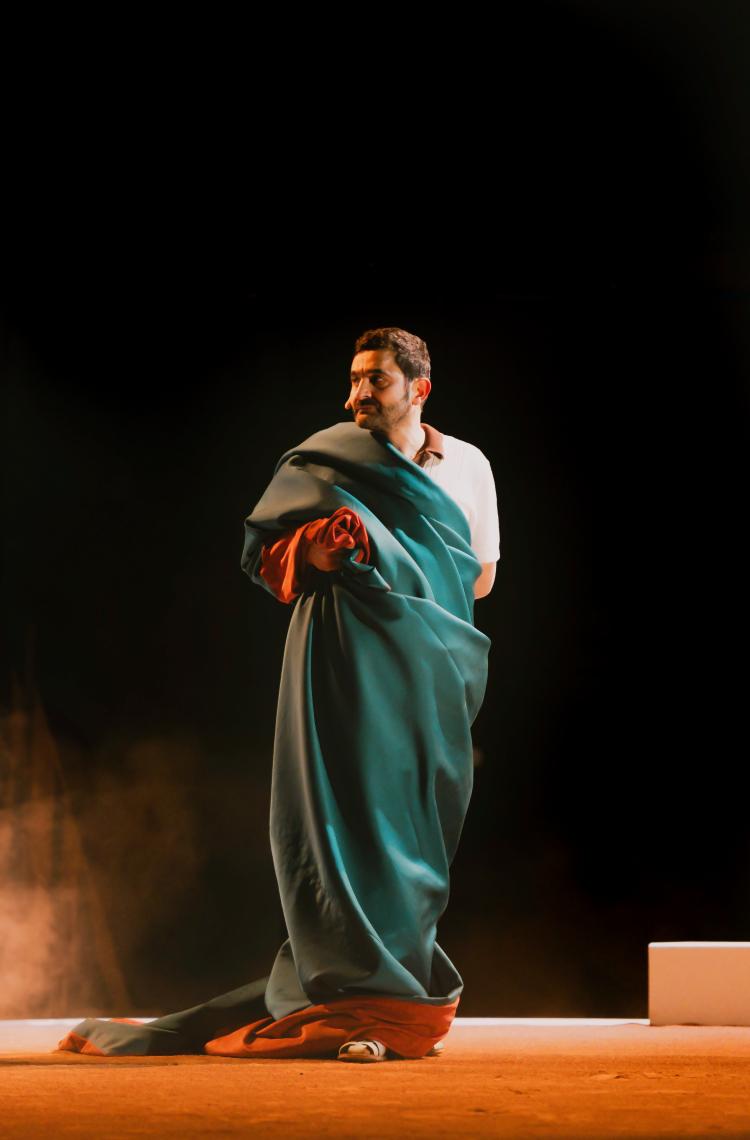
"This is where Maja Zade’s writing sweeps everything before it, like a tidal wave, and leaves us speechless."
Interview with Delphine Edy, the French translator of the play “Oedipus”
If we cannot escape our Fate, can we survive it? Bordering on satire, and exploring themes of power, pollution and family secrets, Héloïse Ravet tackles the German playwright Maja Zade’s feverish reinterpretation of the famous Greek myth. An interview with Delphine Edy, the French translator of this German text.
How did you discover Maja Zade’s work? What, in your view, characterises her style? What makes her work unique?
I discovered Maja Zade through the research I carried out on the productions of Thomas Ostermeier, the director of the Schaubühne in Berlin. In my essay, I examined the way in which he (re)creates literary works for the stage, exploring the space between literature and the stage, in order to better understand the reconfiguration of reality that he undertakes. At the time, Maja Zade was the dramaturg for some of his productions. Then, Thomas Ostermeier directed *Abyme* ([abgrund] by Maja), which was staged at the Gémeaux festival in Sceaux in September 2019, and there I discovered a very distinctive, powerful and radical style of writing. When they staged *Oedipus* for the Epidaurus Festival, I made the trip and it was an exceptional experience: Maja’s language, at the heart of this Greek theatre, seemed to me to offer the myth a tragic setting that I hadn’t expected. This was not merely a rewriting, but the work of an author attuned to tragedy and the torments of our contemporary world. Not only does Maja view the reality around her with rare acuity, but above all she has found a language capable of giving it a form of surgical precision, where the dialogue hits the mark every time.
What role do humour, irony and cynicism play in her plays? How do these elements coexist with particularly serious subjects?
The characters she portrays are most often drawn from the urban, cultured bourgeoisie – and sometimes the middle class. Their language reflects this, and their dialogue rings very true, as if Maja Zade had ‘just’ caught them in the act. Their tone is therefore fast-paced, light-hearted and fluid, whilst at the same time revealing the superficiality of their remarks, the things left unsaid, and their denial in the face of situations that cause them distress. It is most often when they are chatting in the kitchen about the evening’s menu or how to cook pasta that the real tensions emerge and create cracks in their smooth, polished bourgeois facade. Irony is an integral part of her characterisation, but the characters themselves are not necessarily aware of it: often, they do not realise what they are saying; they are funny in spite of themselves, so to speak. There is no cynicism in her work. Maja loves human beings too much, with all their weaknesses, their shortcomings and their fragility.
Whilst translating *Oedipus*, what did you discover about Maja Zade’s writing that might have escaped you on a first reading?
This German language, which I immediately perceived as an instrument of extreme precision and which I wanted to translate for that very reason – because it said something lucid, true and subtle too about our world – proved even more formidable when it came to translating it. This was particularly true in two areas of her writing: when the light-heartedest of subjects are addressed and one must convey the unconscious subtext that lurks beneath, and in those moments when the truth is revealed, when realisation strikes without warning. It is there that Maja Zade’s writing sweeps everything before it, like a tidal wave, and leaves us speechless. It is those very words that are the very essence of translating such a language, and it is a joy that is renewed every time.