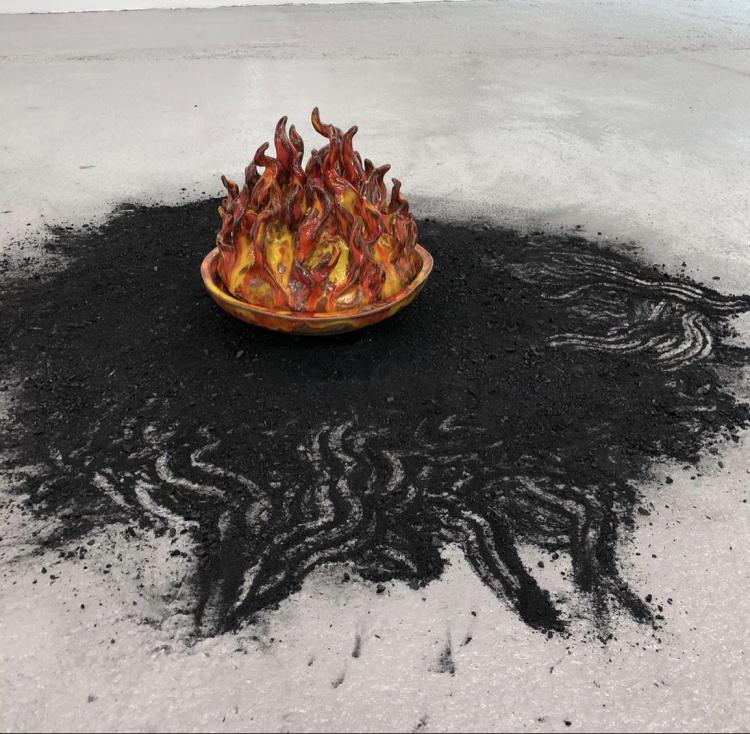
"Inflammatory diseases tell us something about the world we live in and the imbalances that affect it."
Interview with Léa Drouet and Camille Louis about "Rodéo"
People often speak of a ‘sick society’, as if it were an abstract, disembodied collective entity. Yet Léa Drouet and Camille Louis see in the burning forests and our inflamed bodies the tell-tale signs of a tangible conflagration. Transcript of an interview conducted by Sophie Thomine.
How did the Rodéo project come about?
Léa Drouet: The starting point for the Rodéo project was really long Covid. I fell ill four years ago, following a Covid infection. From this immersion in this chronic inflammatory condition, I began to take an interest in the theme of bodily inflammation. We wanted to move beyond the question of my personal story; so we broadened our reflection to include chronic illnesses in general, but also the inflammation of the social body and that of the Earth itself.
Camille Louis: For my part, I listened above all to Léa telling me about her experience of the illness. We often have this idea that we ‘fall’ ill, that illness ‘happens’ to us, or that, all of a sudden, things flare up – that there is a sudden inflammation, whether it be personal, social or environmental.
In reality, experience shows that there is no sudden flare-up. There are always areas of inflammation that have built up over a long period of time. Illness allows us precisely to revisit these stories.
This, I believe, is what the show seeks to share: the inversion, the overturning of a certain narrative surrounding our current collective ills. We live in a profoundly sick age, and the challenge is to succeed in unearthing forgotten stories so that we might inhabit this sick present in a different way.
Why the title ‘Rodeo’?
Léa: When we started working on the theme of inflammation, I happened to meet someone who told me that the practice of burning cars and urban ‘rodeo’ had originated just a few hundred metres from where I grew up, in a neighbourhood that no longer exists: the Cité Olivier de Serres in Villeurbanne. This story resonated deeply with our reflections on what becomes visible through social uprisings and political tensions.
In Lyon, where I’m from, these events helped to build a veritable mythology around working-class neighbourhoods, often associated with the idea of heat, fire or inflammation. Yet this visibility has at times obscured the social realities and political choices that have shaped these areas.
We initially envisaged telling this story within the show, but we quickly realised that it deserved an entire production of its own. I also wanted to avoid appropriating a story that I hadn’t experienced first-hand. Thus, ‘Rodéo’ isn’t its main subject: the title merely retains a trace of it, like an echo of the various forms of revolt that run through the show.
Camille: It almost becomes a symbol – without turning it into a spectacle – of this tendency to over-represent the moment when things go up in flames, which in turn serves to render invisible the very factors that created the conditions for the blaze.
In this story, that is particularly striking. Léa carries out a great deal of research, notably at Le Rize, an archive centre dedicated to the history of Lyon and Villeurbanne. We realise everything that happened in the run-up to it: the harshness of political decisions that created a situation where the outbreak of violence seemed almost inevitable, given how unsanitary living conditions were and how overcrowded people were.
But we also discover everything that has been rendered invisible: the organisation of this revolt, which did not manifest itself solely through burnt-out cars.
The question then becomes: what do we choose to remember from these stories?
How did you collaborate on the text and the staging?
Camille: The script emerged from a constant back-and-forth between the two of us. This is the fourth show we’ve done together and we’ve always worked this way, in a ping-pong exchange between writing and directing.
I often quote Léa’s phrase: ‘I sketch out the broad strokes and Camille adds the sparkle.’
This time, we’ve swapped roles a little: I provided the initial material and Léa took it from there. So the script is written, but it remains in constant dialogue with what happens on stage. The stage reveals what works and what doesn’t.
This is something Léa has always developed in her work: what exists in theatre isn’t limited to the text. Everything is built on the interplay between the text, the lighting, the set design and the sound. Not everything is conveyed by words. Even
before I began writing, I listened to Léa’s stories, those of other patients, and of people campaigning against the destruction of the earthly body… So
the process began with listening, and then came the writing.
Léa: Then came the back-and-forth with the stage.
The stage always ends up imposing its own rules. There are the intentions, of course, but there are also the effects of reality: the bodies on stage, the music, the set design. All of this shapes the text, just as the text sometimes shapes the rest.
We’re engaged in a genuine process of writing for the stage, where each element transforms the others and the whole gradually falls into place.
There isn’t a single text that comes first and around which everything else is organised. In fact, the first sounds and the first visual elements of the set design emerged even before the text began to take shape.
It is an ecosystem that is built together.
Even today, we are at the heart of this process of adjustment. We must remain open to what unfolds and be willing to make changes, without clinging to the text as if it were an immutable truth. It is sometimes a habit in theatre to cling to the written word.
But the written word shifts.
Camille: And it will continue to shift.
The effects of reality are also produced by the collective reality we are experiencing.
Léa: The heatwave, for example.
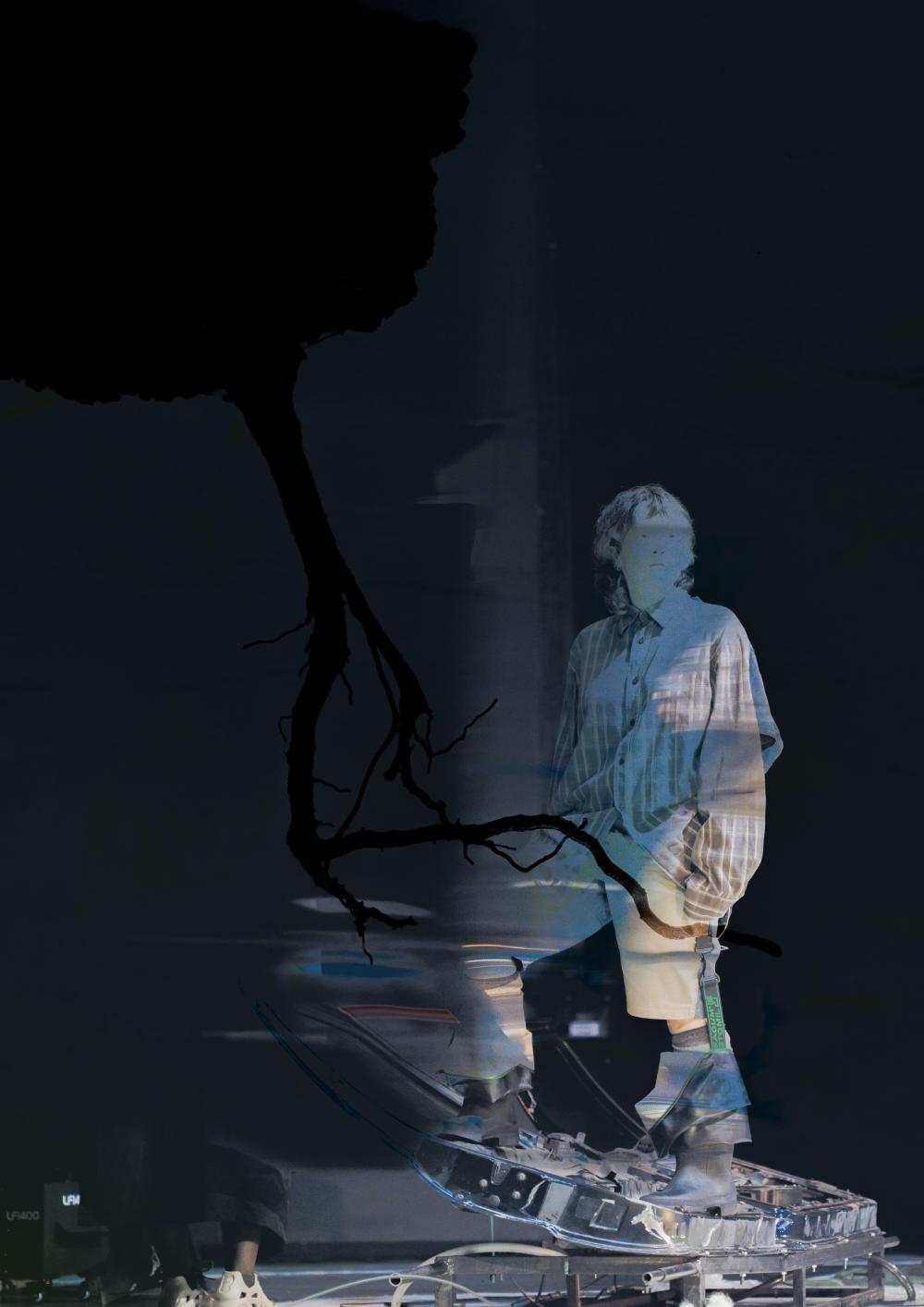
How did you explore the different scales between the individual, inflamed body, the social body and the territory?
Léa: Initially, we envisaged them as distinct fields of exploration. Then our experience on stage led us to believe that everything had to stem from the illness.
For example, regarding the symptoms of long Covid, we quickly realised that simply describing them was less powerful than transforming them into aesthetic directions.
Mental fog, exhaustion and hypersensitivity thus become driving forces behind the staging. The overall atmosphere of the performance is dictated by the physical and sensory experience of the illness.
The sensory experience is therefore central.
This experience of illness forced you to slow down. Do you think that, generally speaking, the world needs to slow down?
Léa: I feel that the bodies expressing themselves today – particularly through the exponential rise in inflammatory diseases – act as warning signals, as sentinels. They tell us something about the world we live in and the imbalances that run through it.
I’m not sure whether we should talk about a general slowdown or systematic degrowth. But I do observe that forced pauses, whether individual or collective, allow us to become aware of the speed at which we are evolving. This constant acceleration is creating environments that are increasingly unsuitable, both for bodies and for ecosystems.
The overexploitation of resources, climate change and disease are all manifestations of this reality. Our bodies, just like the Earth, are sending us messages. Yet we often seem to remain in a state of collective denial.
I believe the challenge is not merely to slow down, but to create moments of pause that allow us to look these signals squarely in the face. For this constant rush prevents us from listening to what is happening to us. We keep moving forward, at the risk of no longer paying attention to the events that are trying to speak to us.
Camille: For me, Covid – and particularly long Covid – perfectly illustrates our difficulty in listening to what is happening to us. When faced with crises, we are constantly seeking a ‘way out’ and a return to normality, driven by a mindset of progress and acceleration. Yet this obsession often prevents us from seeing what is being expressed around us, whether it be warnings, vulnerabilities or emerging forms of resistance. In the play, we propose instead to take a horizontal and circular view of the world, so that we can better come to terms with our paradoxes. We experience these paradoxes in our daily lives: during heatwaves, for example, we open our windows to let in a bit of fresh air whilst aeroplanes – which also contribute to global warming – fly overhead. We sometimes feel that the more we become aware of the dead ends we find ourselves in, the more we continue to accelerate rather than change direction.
Léa: This constant call to ‘emerge from the crisis’ also has the effect of erasing certain collective experiences, even though they are very recent. In the show, we refer in particular to the Yellow Vests movement, the momentum of which was interrupted and then largely overshadowed by other events, such as the Notre-Dame fire or the lockdown. Talking about it today, I’m struck by how much some people have already forgotten what brought those protests to an end. It shows just how successive crises quickly overlap and obscure our collective memory.