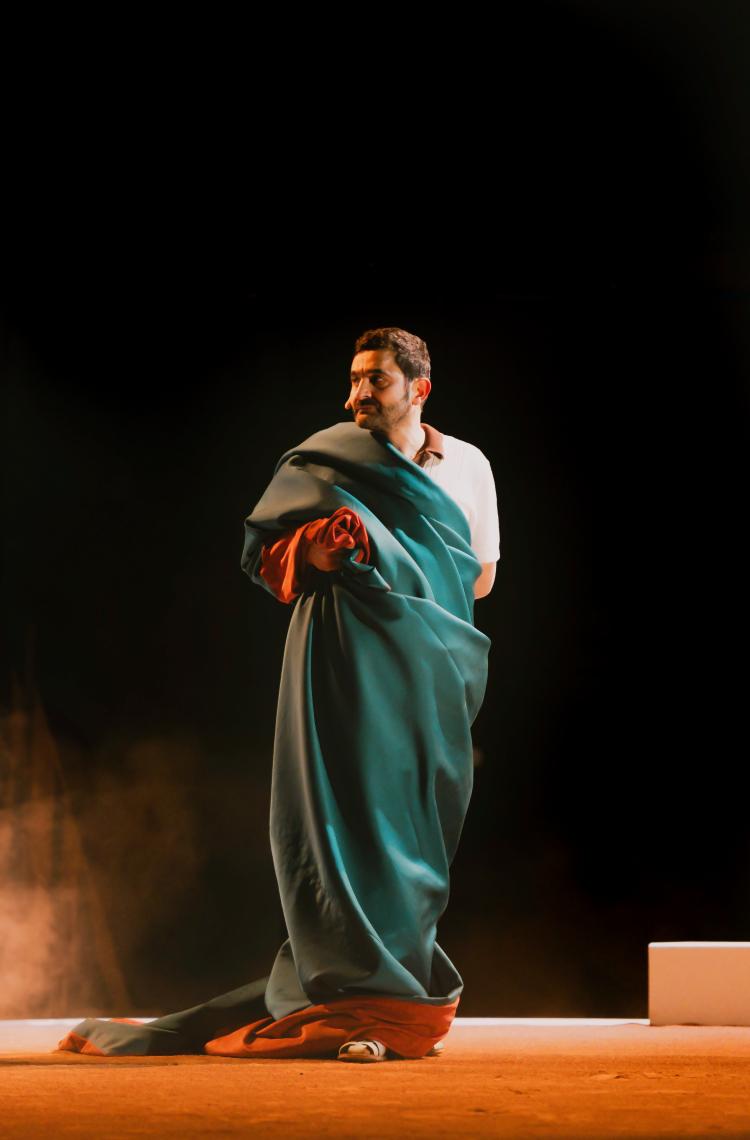
"Not everything is always sacred; not everything is grand. These are people who are constantly trying to rise above themselves, but the theatre can bring them back down to earth. That, too, is part of our human condition."
Interview with Héloïse Ravet about her production ‘Oedipus’
If we cannot escape our Fate, can we survive it? Bordering on satire, and exploring themes of power, pollution and family secrets, Héloïse Ravet takes on the German playwright Maja Zade’s feverish reinterpretation of the famous Greek myth. Interview conducted by Simon Vandenbulke in December 2023 ahead of the play’s premiere at the Théâtre de Liège.
Your first production, *Outrage pour bonne fortune*, was developed as an original play; with *Oedipus*, you’re taking on an existing text. How did you come to make that choice?
I met Serge (editor’s note: Managing and Artistic Director of the Théâtre de Liège at the time of the production’s creation) in 2021, and we had a long discussion about the themes that appealed to me and what I wanted to bring to the stage. I originally wanted to work on an adaptation of *Festen*, written by Thomas Vinterberg himself, but as it had already been staged recently – and several times – we exchanged texts before coming across the reworking of *Oedipus Rex* by Maja Zade, a playwright at the Schaubühne.
The main reason I wanted to work on *Festen* was that I wanted to tackle the issue of incest, and the links that can be drawn between violence within the family and that perpetrated by society. Maja Zade’s text allowed me to tackle these issues with a very contemporary, very caustic style – far more vivid and dynamic than the ancient text. I recognised the issues that still matter to me today: this interplay between individual and relational violence, and violence on a larger scale. The play explores the full spectrum of violence: how an industry inflicts violence on a region, for example; how power dynamics are embedded in longer timeframes, spanning entire lifetimes; how it manifests itself in our language… And above all, what links all these forms of violence together.
Michael, for example – who represents Oedipus – was adopted by a middle-class family and is unable to feel accepted by his wife’s family, who come from high society. He feels as though he is trapped. There is always this dual aspect to violence.
So it is not a question of viewing violence as an isolated incident, but as the result of our societies, where violence unfolds over long periods and can intrude into our personal relationships?
Yes, in our intimate relationships. How can the systemic violence of a society alter our personal relationships, how can it – as you say – intrude into our families, our couples, or even our friendships – Christina and Theresa also have a very ambiguous relationship. We often feel as though we are above such violence, particularly by addressing it through literature and theatre, but in the end, even if we talk about it, there is always domination; there is always power.
So was it the way the text deals with violence that convinced you to stage it?
Yes, particularly the way it does so. The beginning of the play – in fact, almost two-thirds of it – is quite funny; there’s a dynamic reminiscent of a telenovela, with a situation involving problems to be solved, all featuring archetypal characters: the cantankerous brother, the young social climber… Characters we’ve seen a thousand times before, and whom we can have a bit of fun with. The script is structured in such a way that it grabs us – the audience – and turns us on our heads. Take, for example, the moment when the father’s death is revealed – that is, the moment when the play truly enters into tragedy – the writing itself changes; the very short lines give way to longer ones, more akin to classical drama.
I was also interested in this style of writing, as it’s something I seek to achieve in my own work: the reversal, the blending of genres and conventions. This play brings all of that; you never really know what you’re watching, you never know whether it’s funny or sad, whether it’s cynical or tragic… There’s something very hybrid about it… Partly because of the rewriting, of course, but also because of the way Maja Zade introduces an element of the fantastical: a play made up of collages, blending her personal style with elements of the tragedy we’re all familiar with.
So the text is already – in a way – a confrontation between two points of view: that of Sophocles and that of Maja Zade; how, as a director, can you step into this to develop your own point of view?
There are several answers to that. One might be the gaps left by Maja Zade in her text. The play is divided into three acts, each corresponding to a part of the same day. Between each of these acts, it is as though she has left gaps for me to step into. But also everything that happens beforehand… There is much to be said about these gaps, these things that are left unsaid, yet which we sense.
A second answer might lie in the choice of set design – which will also allow for more dreamlike and symbolic touches. By opting for a very minimalist set design that places the performers at the centre of the staging, I’m choosing to ‘rely’ on them; I’m choosing to base the performance on acting that’s as stripped-back as possible, as primal as possible. I’m seeking to shift the writing – which can sometimes come across as a bit verbose – towards an ‘ultra-necessity’ of language.
What do you mean by the ‘ultimate necessity’ of language?
Whereas, in *Outrage pour bonne fortune*, I worked extensively on the necessity of presence, on the gestures – all of which had a particular significance – with *Oedipus*, I’m working on the meaning of every line. I want the audience to think to themselves: ‘This character could not have said anything else’; ‘He had no choice but to say precisely that!’ Even if, at first glance, the characters seem to be talking without saying anything, I don’t want the audience to think that. In reality, they talk incessantly to avoid saying what really needs to be said. Language becomes their only defence, their only protection.
Isn’t language also often used as a weapon?
Maja Zade has a very harsh side to her, quite pessimistic about human nature, about who we are. But at the same time, she does so with a certain humour that I find interesting. Yes, their words are also a weapon, but I like the way they’re constantly attacking one another. Right from the first page, Robert says to his sister Christina: ‘It’s in the morning that you really see your wrinkles.’ The tone is set: they can’t stand each other, and it’s going to last an hour and a half.
Does the brisk pace of the dialogue also imply a certain violence? A certain brutality?
Exactly! I immediately loved the idea of staging a play that never lets up. Maja Zade works solely with ‘white punctuation’ – that is to say, everything that is left unsaid. There’s never a pause, never a silence. Between Michael’s first and last lines, which are identical, there’s no breathing space. I find it very interesting to approach this in the staging, as a long marathon of language and the body. You start and you can’t stop. There’s something of a suffocating quality that I feel it’s important to convey on stage.
What questions did you have about the text? Were there any sticking points?
[SPOILER ALERT] The biggest difference between Maja Zade and myself is undoubtedly at the very end of the play, which differs completely from the myth. Here, Michael throws himself out of the window; in the myth, Oedipus gouges out his eyes and leaves society. I have some reservations about the version proposed by Maja, because it seems to me that the myth allows us to reach a version of reality that we can never attain in real life. It is unthinkable to imagine that one could gouge out one’s own eyes before completely cutting oneself off from society; yes, probably, faced with such horrors being revealed, we would take our own lives. I find it more interesting to write about something we cannot achieve as human beings, to grant ourselves this possibility vicariously through literature and myths. The myth of Oedipus offers us the mad idea that it is possible to survive the unspeakable. That it is possible to detect a shred of humanity even in the most horrific terror. In this day and age, I think it’s important to continue offering ways out, particularly through art. This is yet another paradox I’ll have to grapple with on stage in an attempt to find the best solution… Nor do I rule out the possibility of bringing Oedipus back onto the stage… I still need to explore this disappearance further without, however, doing violence to the original text.
Maja Zade not only alters the play’s ending, she also rewrites the character of Jocasta, transforming her from an almost ghostly figure in the myth into a leading character.
I think this is a brilliant idea. After all, it is through her that the drama unfolds in the original myth… Here, Maja Zade also introduces what I perceive as an ambivalence regarding the liberation of speech. Christina, who plays Jocasta, ends up revealing everything, and things only get worse after that. Whilst preparing for *Oedipus*, I re-read the ancient text, and I’d forgotten that in the myth, Jocasta knows. She knows, and she chooses to remain silent. The chorus then suggests that misfortune stems from this silence. I find this very interesting: whatever Jocasta does, everything unfolds as it does in the myth, and in myths, whatever we do, we cannot escape our fate. I get the impression that, by rewriting this passage, Maja Zade absolves Jocasta of guilt; she shows us that Jocasta is not to blame for either keeping silent or speaking out. Not everything hinges on words, on whether one remains silent or speaks. We need more than just words; we need the right conditions to support those words.
For speech to be liberated, must listening also be liberated?
Yes, we need to create the right conditions to receive it. I wouldn’t want the liberation of speech in the play to be seen as something dangerous. I think we need to speak. The aim is not to silence people, but rather to understand the power of speech… the power of secrecy and its revelation. Speech is a hydra: it can be as salvific as it is destructive… especially when it is not supported… In *Oedipus*, Christina is never supported. From the very beginning, she is completely abandoned, utterly denied. It is because she has never been listened to that her words become destructive.
We’ve talked about speech, but how do you embody it in the actors’ bodies?
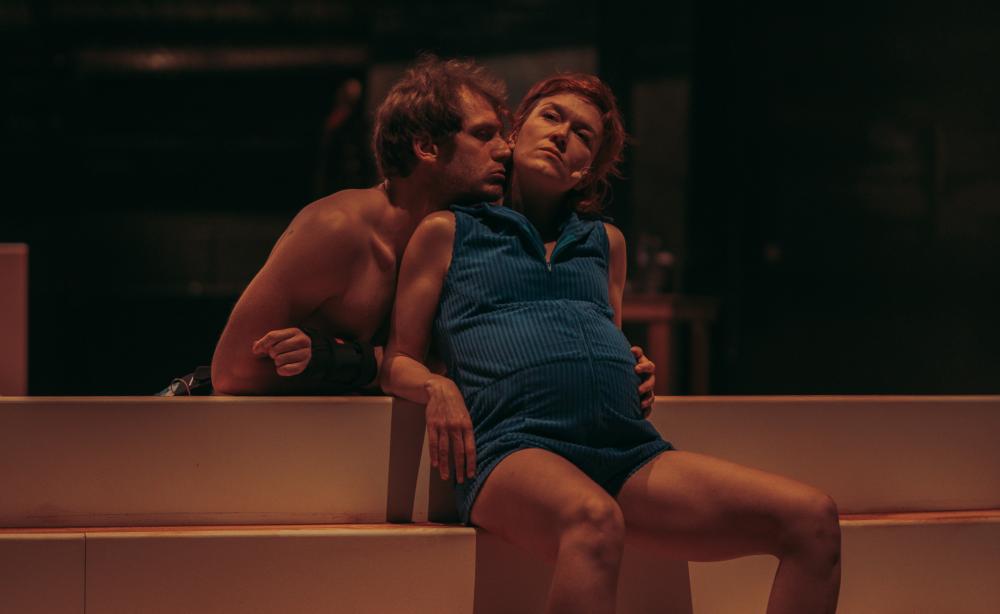
I always work around the question of the body. For example, this is the first time I’ll be working with a prop (editor’s note: Emilie Maquest, who plays Christina, wears a fake belly in the play), which is unusual for me. I work primarily with the actors’ individuality, their particular way of moving. All those little things that are almost invisible, but which have a crucial impact on how one is on stage. I work very little with character roles. I always start with the actor to engage with what is written. The Tg Stan collective has influenced me greatly on this point: if I want to play a little girl, I don’t need to act like a little girl – there’s something of that little girl within me. I find that very true: starting from one’s own identity to find within the character what resonates within us. It brings a touch of universalism: if the actor can do it, then so can we. I’ve taken to heart this image shared by one of my teachers, who told me that directors should work with actors as if they were working with shutters. You have to imagine shutters that have been painted, painted and repainted… The paint is bound to flake off… and the director’s role is to sand, sand and strip away the layers to get down to the raw wood.
Is it this emphasis on the body in your work that leads you to use the writings of Raimund Hoghe – a dancer – to prepare your production?
For me, Raimund Hoghe is first and foremost Pina Bausch’s dramaturg. The writings I asked the actors to read in preparation for *Oedipus* – the ones that inspired me – are, in any case, his dramaturgical writings. Admittedly, he’s a dancer, but he’s quite a strange dancer all the same (she laughs). In any case, he’s a leading figure in the world of movement.
Quelles ont été les interrogations sur le texte ? Y-a-t-il eu des nœuds ?
[ALERTE SPOILER] La plus grande divergence entre Maja Zade et moi-même se situe sans doute à la toute fin de la pièce, qui diffère totalement du mythe. Ici, Michael se défenestre ; dans le mythe, Œdipe se crève les yeux et quitte la société. J’ai une réticence par rapport à la version proposée par Maja, parce qu’il me semble que le mythe permet d’atteindre une version du réel que nous ne pouvons jamais atteindre dans la vie. Il est impensable de s’imaginer qu’on puisse se crever les yeux avant de s’exclure totalement de la société ; oui probablement, devant tant d’horreurs révélées, nous nous suiciderions. Je trouve plus intéressant d’écrire quelque chose que nous ne pouvons pas réaliser en tant qu’être humain, de nous offrir cette possibilité par procuration grâce à la littérature et aux mythes. Le mythe d’Œdipe nous propose l’idée folle qu’il est possible de survivre à l’innommable. Qu’il est possible de déceler une part d’humanité même dans la plus horrible terreur. Dans notre époque, je trouve important de continuer à proposer des échappatoires, par l’art notamment. C’est encore une aporie que je vais devoir confronter au plateau pour essayer de trouver la meilleure solution… Je n’exclus par ailleurs pas le fait de faire revenir Œdipe au plateau… Je dois encore creuser cette disparition sans pour autant faire violence au texte original.
Maja Zade ne modifie pas seulement la fin de la pièce, elle propose également une réécriture du personnage de Jocaste, qui passe d’une figure presque fantomatique dans le mythe au rôle de personnage principal.
Je trouve cette idée géniale. C’est tout même par elle que le drame arrive dans le mythe originel… Ici Maja Zade apporte aussi ce que je perçois comme une ambivalence de la libération de la parole. Christina, qui représente donc Jocaste, finit par tout dire et tout va plus mal ensuite. Pour préparer Œdipus, je me suis replongée dans le texte antique, et j’avais oublié que dans le mythe, Jocaste sait. Elle sait et elle décide de se taire. Le chœur suggère alors que de ce silence arrive le malheur. Je trouve ça très intéressant : quoi que Jocaste fasse, tout se passe à l’endroit du mythe, et dans les mythes, quoi que nous fassions, nous ne pouvons échapper à notre destin. J’ai l’impression qu’en réécrivant ce passage, Maja Zade déculpabilise, elle nous montre que Jocaste n’est coupable ni de se taire ni de parler. Tout ne passe pas par la parole, par le fait de se taire ou de parler. Il faut autre chose que simplement la parole, il faut les conditions pour accompagner cette parole.
Pour une libération de la parole, il faut également une libération de l’écoute ?
Oui, il faut créer les bonnes conditions pour la recevoir. Je ne voudrais pas que la libération de la parole dans le spectacle soit vue comme une chose dangereuse. Je pense qu’il faut parler. Le but n’est pas de faire taire les gens, mais plutôt de comprendre la puissance de la parole… la puissance du secret et de sa révélation. La parole est une hydre : elle peut être salvatrice autant que destructrice… surtout quand elle n’est pas accompagnée… Dans Œdipus, Christina n’est jamais accompagnée. Depuis le début, elle est complètement abandonnée, totalement niée. C’est parce qu’elle n’a jamais été écoutée que sa parole devient destructrice.
Nous avons évoqué la parole, mais comment l’inscrire dans le corps des acteurs ?
Je travaille toujours autour de la question du corps. Par exemple, c’est la première fois que je vais travailler avec un postiche (ndlr. Emilie Maquest, qui interprète Christina, porte un faux ventre dans la pièce), ce qui est particulier pour moi. Je travaille surtout avec la singularité des acteurs, leur manière particulière de se déplacer. Toutes ces petites choses presque invisibles, mais qui ont un impact essentiel sur la manière d’être au plateau. Je travaille très peu avec des rôles de composition. Je pars toujours de l’acteur pour rencontrer ce qui est écrit. Le collectif Tg Stan m’a beaucoup influencée sur cette question : si j’ai envie de jouer une petite alors je n’ai pas besoin de faire la petite fille, il y a en moi quelque chose de cette petite fille. Je trouve ça très juste, partir de sa propre identité pour trouver dans le personnage ce qui résonne en nous. Cela apporte une touche d’universalisme : si l’acteur le fait, alors nous aussi nous le pouvons. Je retiens cette image donnée par l’un de mes professeurs qui me disaient que les metteurs en scène devaient travailler avec les acteurs comme s’ils travaillaient avec des volets. Il faut imaginer des volets qui ont été peints, peints et repeints… La peinture s’écaille forcément… et le rôle du metteur en scène, c’est de poncer, poncer, de décaper pour arriver au bois brut.
Est-ce cette importance du corps dans votre travail qui vous pousse à utiliser les écrits de Raimund Hoghe – un danseur – pour préparer votre mise en scène ?
Raimund Hoghe, c’est avant tout pour moi le dramaturge de Pina Bausch. Les écrits que j’ai demandé aux acteurs de lire pour préparer Œdipus, ceux qui m’ont inspiré, sont en tout cas ses écrits dramaturgiques. Certes, c’est un danseur, mais c’est un danseur assez étrange quand même (Elle rit). C’est en tout cas une personnalité du mouvement.

So is there a certain influence from dance here?
In theatre, there is first and foremost the text, as in *Oedipus*, or the plot, as in *Outrage pour bonne fortune* or *Larrons en baskets bleues* (editor’s note: a previous production by Héloïse Ravet), and then there is everything that lies beneath. And that ‘beneath’ is the body. It’s almost like psychoanalysis, a sort of ocean floor that we all have within us and from which we cannot escape. In my theatre, I seek to reunite these two aspects; the possibility of having two stories within a single being: the story that is told and the story that is seen. Working on the movement of a shoulder, a hand, a particular gesture – all of which convey something other than what is spoken on stage.
Where I feel I have a close connection with choreography is in the relationships between the actors. All too often in theatre, actors perform their own parts, alone. In dance, the notion of the group is more prominent; there is a focus on the balance of the bodies, a tension between them. I always try, even when we’re working with a script, to create a connection – almost a mystical one – between the bodies of those who are speaking to one another on stage.
It’s all this work I do on the body, particularly through warm-ups: how to feel vibrations passing from one body to another, how my own movement is influenced by another actor’s movement, and so on. These are exercises that might seem a bit silly, but which make a real difference to me. I wouldn’t want an actor to feel as though they’re speaking into the void, alone, with no one to receive their words. It always happens in a play that a character starts speaking at greater length, but they can only ever speak because the other person is there. How to receive what is said. That’s what interests me! All the more so in *Oedipus*, where what matters is not so much what is said, but rather the way in which those words are received. It’s a question of listening: how do you survive the chaos of listening?
There’s a reference I’m particularly fond of in Claude Berri’s diptych: *Jean de Florette* – *Manon des Sources*; which, incidentally, can be linked to *Oedipus Rex*. When you think about it, it’s a truly ancient concept; it’s a myth. There’s this scene at the end of both films where Yves Montand’s character, after causing the death of his son whom he never knew – and whose tragedy was that he had no children – slumps almost imperceptibly. He says nothing; it all happens in that shoulder which drops by a few millimetres. I find it so spot-on, so powerful! That’s what I want to capture – that movement. To show that utter devastation, so profound that words are no longer enough. The only thing left to us is that inner collapse, which is barely perceptible.
Is your very minimalist set design, then, also a way of amplifying the presence of the actors’ bodies on stage?
I don’t think it’s very interesting to show what’s being said. I chose to move away from the Greek villa where the action takes place because that’s already stated in the text. We know where they are, we know it’s hot, and so on. On the other hand, it’s interesting to act it out. The actors don’t necessarily need crutches to perform, and the audience doesn’t need crutches to understand what’s happening. That is why I swapped the sun-drenched villa for a trestle stage. Now it is solely the actors, their bodies and their actions that draw us into the story.
The open-air theatre was my primary influence for the set design. In practical terms, it will feature a raised performance circle, to which we’ve added steps reminiscent of the open-air theatres of the past, when people would climb onto the stage to bring the play to life. I wanted to return once more to something very raw. To this, we must add several references: the circle – covered in red clay – also evokes the arena, the bullfight, which was a second influence. I see Michael/Oedipus as a hunter who eventually realises he is the hunted beast. He is the hunter being hunted (She laughs). There is also something in bullfighting that recalls dance, the connection between two beings – however tragic that connection may be. Finally, I also like the fact that this circle evokes a circus ring. As if these four characters had come to perform their little act.
So there’s also a certain influence from the grotesque?
Yes, exactly. The costumes will also emphasise this grotesque, slightly zany side. They’re eccentric people; they’re strange, bizarre. They don’t represent the image we have of high society at all.
I want to add a very colourful, rather kitsch touch. Michael, for example, is in his swimming trunks for much of the show. I wanted to develop a character who learns of his father’s death – a father he himself killed – whilst wearing just his underpants (She laughs). It’s the idea that life can be utterly grotesque and ridiculous. Life is full of absurd, improbable situations. Not everything is always sacred; not everything is grandiose. These are people who are constantly trying to elevate themselves, to make themselves seem greater, but theatre can bring them back down to earth… That, too, is part of our human condition…
Interview conducted by Simon Vandenbulke in December 2023 prior to the premiere of the production at the Théâtre de Liège.